
Speed bumps do a quiet but critical job. Day after day, they slow vehicles, protect pedestrians, and reduce accidents in parking lots. But like any pavement feature, they don’t last forever—and when they start to crack, crumble, or fade, the consequences can be more serious than most business owners expect.
The problem is that speed bump deterioration tends to happen gradually. A small crack here, some faded paint there—it’s easy to put off repairs when the damage seems minor. But left unaddressed, that minor damage can escalate into a genuine safety hazard, a liability risk, and an expensive replacement project.
This guide breaks down why speed bumps deteriorate, what warning signs to watch for, and what your options are when it’s time to repair or replace them.
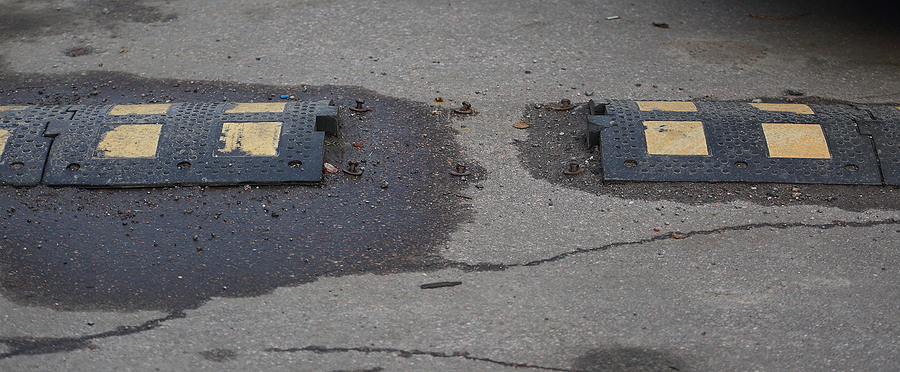
Why Speed Bumps Deteriorate Over Time
Speed bumps take a beating. Every vehicle that passes over one applies direct force to the pavement structure—and in a busy commercial parking lot, that adds up fast. But heavy traffic isn’t the only culprit.
Freeze-Thaw Cycles
For business owners in Indianapolis, winter weather is one of the most destructive forces acting on your parking lot. When moisture seeps into small surface cracks and then freezes, it expands. That expansion puts tremendous pressure on the surrounding asphalt or concrete, widening cracks and breaking apart the material from the inside out. Each freeze-thaw cycle compounds the damage, and Indiana’s winters provide plenty of them.
UV Exposure and Oxidation
Sunlight degrades asphalt over time. UV rays cause the binders in asphalt to oxidize, making the surface brittle and more prone to cracking. This is also why speed bump markings—the yellow or white paint that makes them visible—fade so quickly. A speed bump that’s lost its markings is one that drivers may not see in time to slow down.
Heavy Traffic and Repeated Impact
Delivery trucks, SUVs, and service vehicles exert far more force on speed bumps than standard passenger cars. Over time, this repeated impact breaks down the structural integrity of both asphalt and concrete speed bumps, especially near the edges where the material is thinnest.
Poor Installation and Age
Even a well-built speed bump has a finite lifespan. According to industry data, asphalt speed bumps typically last 8–12 years before requiring restoration, while concrete installations can remain effective for 15–20 years with proper maintenance. When installation quality is poor—inadequate compaction, wrong materials, or improper dimensions—deterioration begins much sooner.
The Safety and Liability Risks You Can’t Ignore
A cracked or crumbling speed bump isn’t just an eyesore. It’s a hazard.
Vehicle Damage and Pedestrian Risks
When a speed bump shifts or breaks apart, sharp edges and raised chunks of asphalt can damage tires, wheel rims, and undercarriage components. Pedestrians, especially those using mobility aids or navigating the lot at night, can trip on uneven or missing sections. Faded markings make the bump nearly invisible to drivers approaching at speed.
Your Legal Exposure as a Property Owner
As a commercial property owner, you have a legal duty to maintain your parking lot in a reasonably safe condition. That duty extends to speed bumps. If a customer, employee, or visitor is injured or their vehicle is damaged because of a deteriorated speed bump you knew about—or should have known about—you can be held liable.
Establishing negligence in these cases typically involves proving that the property owner owed a duty of care, breached that duty by failing to maintain the property, and that the breach directly caused the injury or damage. Damaged, poorly marked, or structurally compromised speed bumps make that case easier to prove.
Regular inspections and prompt repairs are your best legal protection.
What It Costs to Delay Repairs
Small problems rarely stay small in pavement maintenance. A hairline crack that could have been sealed for a few dollars per linear foot can widen into a structural failure that requires full reconstruction. The financial math is unforgiving.
Research from PaveConnect found that a preventive maintenance approach can save property owners up to 37% of total cost per year compared to a reactive approach—where repairs only happen after something fails. Emergency repairs require more materials, more labor, and often more time without a fully functional parking lot.
Beyond direct repair costs, there’s the less obvious cost of perception. Customers notice a neglected parking lot. Crumbling infrastructure sends a message about how a business values its property—and by extension, how it values its customers.
How to Assess Speed Bump Damage
Before calling a contractor, it helps to know what you’re looking at.
Visual Warning Signs to Watch For
Walk your parking lot and look for:
- Deep cracks or fractures running across or along the speed bump
- Missing chunks or crumbling edges, particularly at the base of the bump
- Faded or invisible pavement markings, making the bump hard to see
- Surface raveling, where the asphalt surface has loosened and begun to break apart
- Settlement or shifting, where the speed bump has sunk, tilted, or separated from surrounding pavement
When to Repair vs. When to Replace
Minor surface cracking and faded markings can often be addressed with patching and repainting. But if a speed bump has lost structural integrity—significant missing material, deep cracking, or visible shifting—repair may only be a temporary fix. In those cases, full replacement is typically the more cost-effective long-term solution.
A professional parking lot paving assessment will give you a clearer answer than a visual inspection alone.
Repair and Replacement Options
Patching and Crack Sealing
For speed bumps with surface-level cracking, hot-pour crack sealant or asphalt patching material can prevent water infiltration and slow further deterioration. This is a cost-effective solution when the underlying structure is still sound.
Pavement Marking Refresh
Faded yellow or white speed bump markings can be repainted at relatively low cost. This simple step restores visibility and reduces accident risk almost immediately—it’s one of the most impactful quick fixes available.
Full Replacement
When a speed bump is structurally compromised, replacement is the right call. A new asphalt speed bump, properly installed, can last 15–25 years. The upfront investment pays for itself many times over compared to repeated asphalt patching on a failing structure.
Sealcoating for Preventive Protection
Applying a sealcoat to your parking lot—including speed bumps—creates a protective barrier against UV rays, water infiltration, and oxidation. Sealcoating every 2–3 years is one of the most effective preventive maintenance strategies available to property owners.
Frequently Asked Questions
How often should speed bumps be inspected?
Speed bumps should be visually inspected at least twice a year—ideally in spring after freeze-thaw season, and again in fall before winter weather sets in. Any visible damage should be assessed by a professional promptly.
Can damaged speed bumps be temporarily fixed?
Minor cracks can be sealed temporarily using commercial crack filler, but this is not a long-term solution. Temporary fixes slow deterioration; they don’t restore structural integrity. A professional assessment will determine whether a permanent repair or replacement is needed.
What is the typical lifespan of a speed bump?
Asphalt speed bumps typically last 8–12 years before requiring restoration, with a potential lifespan of 15–25 years with regular maintenance. Concrete installations can last 15–20 years with proper upkeep. Rubber speed bumps have a shorter lifespan of 3–10 years.
How much does speed bump repair or replacement cost?
Costs vary based on material, size, and extent of damage. Asphalt speed bump installation typically ranges from $1,500 to $5,000. Preventive crack sealing is significantly more affordable, often running $0.50 to $3 per linear foot. Getting a professional on-site estimate is the most reliable way to understand your specific costs.
Keep Your Parking Lot Safe—Before Small Problems Become Expensive Ones
Damaged speed bumps don’t fix themselves. What starts as surface cracking can turn into a structural failure—and a safety liability—faster than most property owners expect. Regular inspections, timely repairs, and a proactive maintenance plan are the most effective tools you have.
ACI Asphalt & Concrete serves business owners across Indianapolis with professional parking lot maintenance, speed bump repair, and full replacement services. Whether you’re dealing with visible damage or just want a professional assessment of your lot’s condition, our team is ready to help. Contact us today to schedule your estimate.
Related Posts:
Concrete Parking Lot Repair: Where to Begin
Faded Parking Lines? When To Restripe Your Property
Choose ACI for Bollard Post Services in Indiana